
Where's your head at?
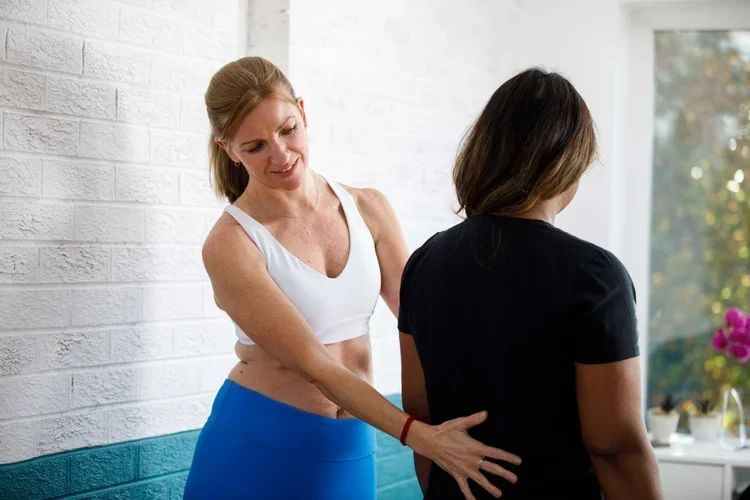
Did you know the average weight of a head is around 4-5kg? That’s the equivalent of 5 bags of sugar, sitting on top of your spine all day long. It’s no wonder so many of us carry a ton of tension and tightness around the neck, shoulders and upper back as they try to lug that heavy weight around.
But if your head is positioned directly over your spine, rather than out in front of it, the bones of the spine can take the bulk of the weight, there’s less effort needed and the muscles can relax a little.
The problems start when the head starts to shift forward. Screen work, makeshift home offices, phones, driving, nursing babies… we do so many activities that shift the head forward. For every 1cm the head shifts forward, the load to the neck and upper back muscles increases by around 5kg. That means if your head is 5cm in front of your spine, that 4kg bag of sugar can soon become a 25kg kettlebell. And it’s the muscles of your neck, shoulders and upper back that are trying to hold it there.
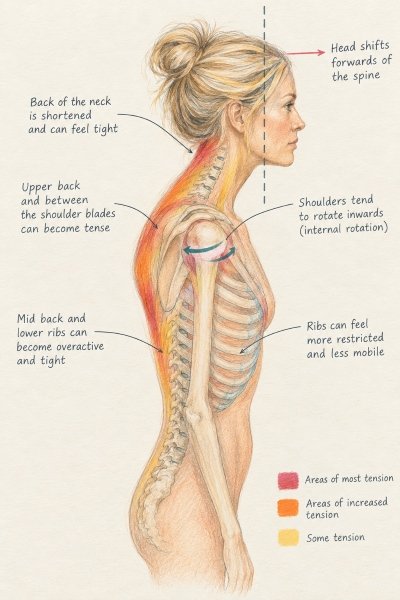
How a forward head position can affect the neck, shoulders, upper back and ribs.
Stress changes things too
It’s not just screens that bring our head forwards.
When you’re stressed, under pressure or deeply focused on something, your nervous system automatically moves into a state of high alert. Our attention narrows, our muscles become more active and we can unconsciously shift our head forwards, tighten our shoulders and clench our jaw. Really useful if you’re eyeballing a sabre toothed tiger and preparing to either fire a shot or run for your life. Not so useful if you’re sitting in a traffic jam, reading an incendiary article on your phone or racing to meet a work deadline.
Your ribs, breathing and core
As I remind you in every yoga or pilates class at Move Well, nothing in the body works in isolation, and it’s all connected. If the muscles of the upper back become tense and restricted because they are trying to carry your heavy head around, that restriction sets off a chain reaction elsewhere. The spine begins to flex, the chest shifts back, collarbones narrow and shoulders curl forward. At the back of the body, the shoulder blades get pulled wide, the back ribs become restricted and the muscles of the upper back lock into a state of restricted movement.
As the lungs live inside the ribs, restriction in the ribs, upper back or chest can all affect how you breathe.
The breath becomes shallow, ribs aren’t able to fully expand to enable the diaphragm to move easily and the muscles around the collarbones and neck over work to try and draw in more breath.
This can create a vicious circle. More tension around the neck and shoulders can make breathing feel more restricted, which can encourage even more tension.
Your breathing also has an important relationship with your core and pelvic floor. As I explained in this blog, every breath changes the pressure inside your abdomen, with the diaphragm, abdominal muscles and pelvic floor working together to manage that pressure.
When we constantly brace, hold our breath or the breath becomes shallow, we can lose some of that natural coordination.
So if your neck and shoulders always feel tight, it might be worth looking beyond the neck.
Sometimes the answer is not to stretch the tight muscles harder, but to improve movement through the upper back and ribcage while building strength in the muscles that can assist in shifting the head back into ‘neutral’.
So what can you do?
The answer isn’t to spend all day trying to hold yourself in perfect posture. In fact, staying rigidly upright can create a whole new set of tensions.
Instead, think movement, variety and awareness.
Try to:
Change position regularly rather than staying in one posture for hours.
Add some side bends into your day. This movement is great for getting the upper back and ribs moving. Visualise your ribs opening like a slinky as you bend in each direction.
Build strength in the muscles of your upper back. Exercises such as mini cobra, locust or cow from yoga, or swimming on the reformer are great for improving mobility while building strength.
Set a timer to remind you to look up from your screen every so often. Focusing on something far in the distance for a few minutes will expand your peripheral vision and give your nervous system a little reset.
Practice breathing into your back ribs. Place a soft yoga strap around your back ribs and try to direct your breath into the strap. Visualise your back ribs opening like a parachute as you inhale, and softly recoiling as you exhale. This can be done when driving or at your desk, using the seat behind you to 'inflate' your ribs into.
Invest in an 8" inflatable Pilates ball, [like this one](LINK TO PRODUCT). Inflate it half way and lie with it between your shoulder blades, head supported so neck stays long. Rest there for a few minutes, guiding your breath into your back ribs.
Join a class. In every class during October we will be prioritising organisation of the head, neck and shoulders, which will have a huge influence on everything further down the chain. We'll be using pilates balls, yoga straps and blocks to improve mobility, build strength and untangle tension.
Move Well, feel well.