
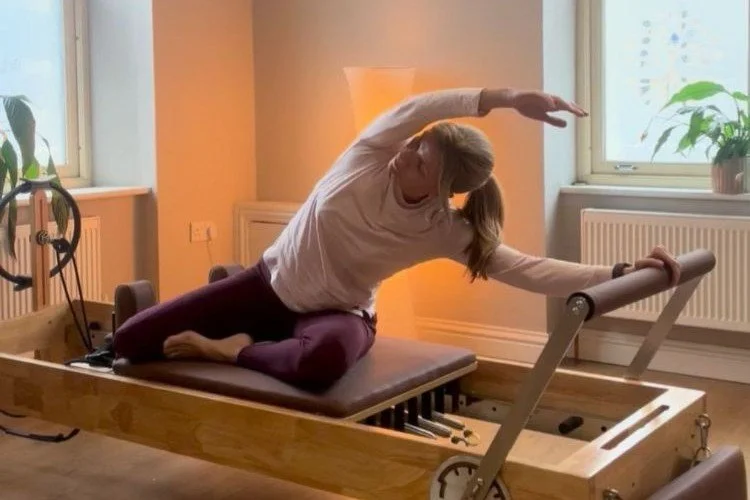
Does it take you a while to straighten up in the morning, after a night in bed? Or maybe you’ve noticed your head doesn’t turn quite as freely as it used to when you’re checking the oncoming traffic at a junction?
It's easy to put these changes down to getting older. But while our bodies naturally change with age, how freely and comfortably we move is influenced by much more than the number of birthdays we've racked up.
Joseph Pilates, creator of the method we now know as Pilates, famously said, "You're only as old as your spine is flexible."
It’s a statement that underpins pretty much every yoga or Pilates class we teach at Move Well. In my 20 years of teaching, I've seen clients of all ages and abilities move with grace and ease. I’ve also seen young, fit clients struggle with basic movements. The main differentiator: how well their spine moves and supports the rest of their body.
Your spine is made to move
Your spine is an extraordinary piece of engineering. Made up of individual bones, joints, cushioned discs and supporting muscles, it allows you to bend forwards, reach sideways, arch backwards and twist. Its curves, discs and surrounding muscles also help distribute forces and absorb some of the impact as you walk, run or go about your day.
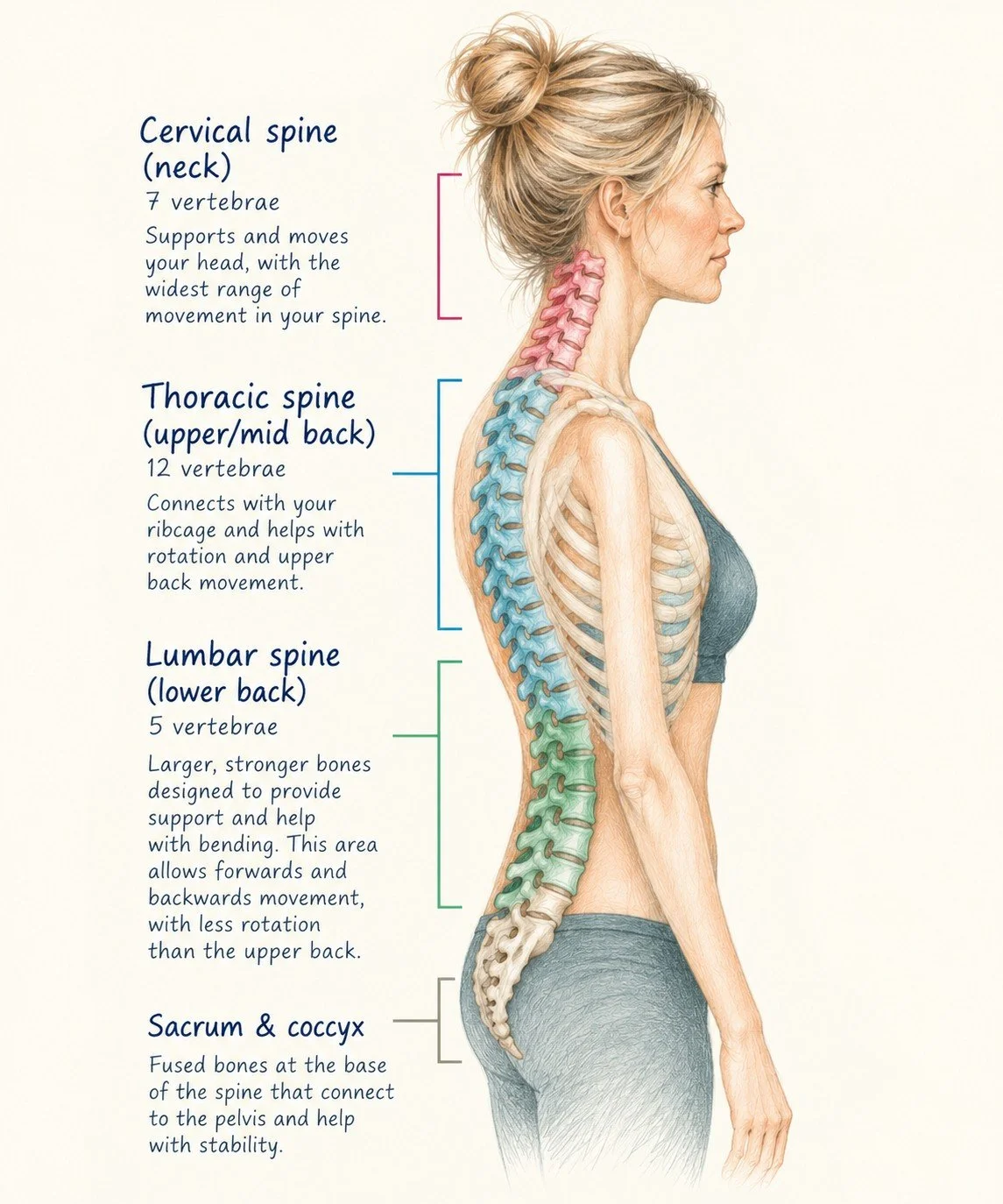
How a forward head position can affect the neck, shoulders, upper back and ribs.
Different parts of your spine have different jobs.
Your neck allows you to turn your head, and has the biggest range of movement in your spine. Super important if you’re sneaking through the bushes hunting prey and need a huge peripheral vision, but vastly under-used in our modern, screen-led life. If your neck is restricted, your shoulders, upper back and breathing can all be affected. You can read more about that in October’s blog, Where’s Your Head At?
Your upper back, or thoracic spine, works with your ribcage to help you rotate, bend sideways and curl forwards. Its vertebrae are designed to glide smoothly on top of one another to facilitate twisting.
Your lower back, or lumbar spine, has larger vertebrae to help support the weight of your upper body. It contributes to bending forwards and backwards, while allowing less rotation than the upper back.
Together, these different areas enable movement in all directions.
But if some areas move less, others may have to work harder to compensate. Add long periods of sitting, driving or looking at screens, and it's easy to see how our movement habits can become a little one-sided.
Keeping your spine healthy isn't simply about moving more. It's about moving the right parts, sharing the workload and helping your spine work as a whole.
Share the load
Think about twisting to look over your shoulder. Ideally, your head, neck, upper back and ribcage all contribute to the movement.
But if your upper back doesn't rotate comfortably, you may twist further through your neck, or try to twist from your lower back. Your body is brilliant at finding workarounds and shortcuts, but repeatedly asking the same areas to do more than their fair share can contribute to irritation.
Ideally, we want a little movement in lots of places, rather than lots of movement in just a few areas.
Bendy when needed; stable when needed
A supple spine also needs to know when to put on the brakes. If you’ve ever watched a Cirque du Soleil performance, you'll know that extraordinary flexibility also requires extraordinary strength and control.
The same principle applies to everyday life. Imagine walking along an uneven path. Your body makes countless small adjustments to keep you balanced. You don't consciously instruct every muscle to contract; your nervous system coordinates these responses automatically.
The same happens when you reach for something, lift a bag or step off a kerb. Sometimes your spine needs to be relatively stable to manage a load. At other times, it needs to move freely.
Your muscles need to respond at the right moment, with the right amount of effort. The aim isn't a spine that's always flexible or always stable. It's a spine that knows how and when to be both.
Constantly gripping your tummy and holding your back rigid can make movement harder than it needs to be. I see this all the time in our yoga and Pilates classes, which is why I often remind people to keep breathing freely. It’s impossible to grip or brace when your breath is flowing freely. Equally, flexibility without the stability and control to support it can also cause injuries.
We need to train both: movement when it's needed, and support when it's needed.
A few things to try every day
You don't need a complicated routine to start giving your spine more variety. Try these simple changes, staying within a comfortable range and avoiding movements that cause pain.
Change position regularly. If you spend a lot of time sitting, get up, walk around or reach in a different direction every so often. A little movement often is more valuable than loads of movement followed by loads of sitting.
Aim for a little movement in a lot of places. When moving through exercises like cat/cow, notice if you can create a little moment in each vertebra, rather than only arching through the lower back and only rounding through the upper back.
Move through all planes often. Teaching your spine how to move back and forth, such as in cat/cow; side to side, such as in mermaid; and to twist through all parts is an ideal way to ensure every part of your spine is getting movement.
This short video explains how to ensure your spine is moving in a balanced way, and why that matters for your core and pelvic floor. In this video, I guide you through how to perform cat/cow without resorting to your spine’s usual cheats.
Can yoga and Pilates help your back?
Research suggests it can. A systematic review published in Disability and Rehabilitation in 2024 found that Pilates can help reduce lower back pain.
Both Pilates and yoga give us the opportunity to work on spinal mobility, strength, coordination and breathing together, in a slow and mindful way. We can explore how different parts of the body move, how they support one another, and how to build control without unnecessary tension.
Exercises can be adapted to suit different bodies and abilities. You don't need to be flexible, strong or pain-free before you start.
How can you start to move better?
At Move Well Studio, every yoga and Pilates class we teach encourages you to become more mindful of how you move, how you breathe and ultimately how you enjoy life. We're not simply chasing stronger muscles or bigger stretches. We're helping you develop a body that moves with greater freedom, coordination and confidence, whether you're a circus performer or a granny trying to pick up her grandchild.
If you'd like to explore this for yourself, we’d love to welcome you to a class. You don't need to be flexible or experienced to start, you just need to take the first step.
Move Well, feel well.