
What Is Core Strength? Why It’s About Much More Than Your Abs

This month we’re focusing on the core at Move Well. But what actually is the core, and how do you strengthen it?
If you believe core strength is all about abdominal exercises, crunches, planks and hundreds of sit ups until your abs ignite, it might be time for a rethink.
While these exercises definitely work your abdominal muscles, your core is much more than a set of abs.
In fact, your core isn’t one single muscle. It’s an intelligent pressure management system that is constantly organising and adapting to what the rest of your body is doing. It’s made up of a whole series of muscles and influenced by everything above, below and all around it.
So rather than trying to make your abs tighter, harder or permanently switched on, training your core requires teaching the whole system to be responsive, adaptable and efficient.
If you’ve ever been instructed to ‘switch on’ your core, I wouldn’t be surprised if that caused a little confusion.
Trying to pull your navel towards your spine, tighten your abs, keep them held and continue moving and breathing is enough to send anyone’s nervous system into meltdown.
Excess tension can create more tension, breathing can become restricted, movement can become compromised, and stress skyrockets as your body and mind try to fathom out something that isn’t innate or complementary to real life movement.
For your core to work efficiently, it needs to know how to soften and when to tense; how to lengthen and when to shorten. It needs to respond appropriately to whatever your body is doing, with just the right amount of effort for the task.
What does an efficient core need?
An efficient and responsive core system requires all of the following:
Three dimensional breathing: allowing your diaphragm, ribs, abdominal wall and pelvic floor to expand and contract three dimensionally with every breath, without force or tension.
Supportive alignment: organising your ribcage, pelvis and spine so they can relate to each other efficiently.
Spinal mobility and stability: allowing your spine to move fluidly in all the ways it was designed to, while developing control and stability where it’s needed.
Whole body movement: fluid, effortless movement from feet to head as you move through life.
Pressure management: learning to coordinate your breath, movement and pelvic floor, allowing expansion on the inhale and recoil on the exhale rather than gripping, tensing or bracing.
Awareness: noticing where you habitually grip, hold or create unnecessary tension.
And you were told you could just pull your belly in and it would magically get stronger.
Fortunately, all of these fundamentals underpin everything we do at Move Well, whether you’re on the Reformer, on your mat, moving through a yoga practice or simply resting and breathing.
Managing the pressure
When I’m working one to one with a client, I’ll often describe your core as a pressurised container.
Like all containers, it has a top, bottom, front, back and sides, and all of those parts need to work together.
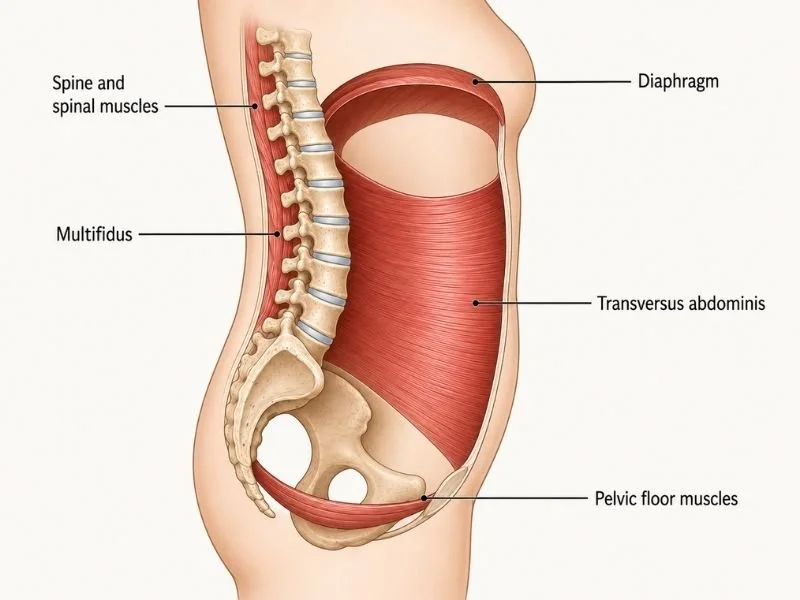
At the top of the container is your diaphragm, your primary breathing muscle. It sits at the base of your ribcage and is shaped a little like an open umbrella.
When you inhale, your diaphragm contracts and moves downwards, creating a gentle change in pressure within your abdomen, a little like a balloon being gently pressed from above.
As your diaphragm descends, your ribs expand, your abdomen gently inflates and your pelvic floor lowers to accommodate that change in pressure.
As you exhale, the reverse happens, like a balloon gently releasing some air.
This happens thousands of times a day, with every single breath, without you having to think about it.
Your breath is therefore one of your body’s most important and most overlooked systems for managing pressure, and in turn helping your core stay healthy, happy and strong.
If your abs are braced, your posture is hunched or your body or mind is tense, your breath can become restricted and unable to move three dimensionally.
Learning to gently allow your belly, ribs, sides of the body and chest to expand as you inhale is one of the foundations of a happy and healthy core.
At the base of the core container is your pelvic floor, a group of muscles that support your pelvic and abdominal organs. And yes, men have a pelvic floor too.
Your pelvic floor works in partnership with your diaphragm and abdominal wall. It responds to changes in pressure and movement, adapting as you breathe, move, lift, cough, laugh, run and jump.
If you’ve spent years working on squeezing and lifting your pelvic floor muscles, that excessive tension can interfere with your ability to manage pressure effectively, and therefore with how your core functions.
At the back of the core container is your spine, with all its joints, discs and layers of muscles designed to keep you upright, stable and mobile.
How your spine moves hugely influences how healthy, strong and adaptable your core is.
If you spend your day hunched over a computer or constantly looking at your phone, your spine can adapt by becoming more rounded and less mobile.
A healthy balance of mobility and stability in your spine is essential for your core to work efficiently.
At the front and sides of the core container is your abdominal wall, several layers of muscles that help move your spine, support your trunk and contribute to managing intra abdominal pressure.
It’s this area most of us think about when we’re told to ‘work the core’.
But to remain stable, adaptable, strong and supportive, your entire core container needs attention, not just the front.
So while crunches, planks and other abdominal exercises might be useful for strengthening the abdominal wall, they are just a tiny piece of the whole picture.
In every class at Move Well, we train your body to manage different loads, coordinate complex movements and gauge just how much effort is required for the task, all while maintaining relaxed and easeful breathing.
We use your breath as our gauge, because it tells us when you’re trying too hard, when movement is being compromised or when you simply need to do less.
When the breath can keep flowing, movement can become fluid, graceful and effortless, even though every muscle is working, lengthening and supporting.
Because a strong core isn’t one that works the hardest, but one that can do the hardest work with the least amount of effort.
And that’s what we’ll be exploring throughout September at Move Well.
→ View our classes and timetable