
Mat Pilates vs Reformer Pilates: What's the difference and which is right for you?
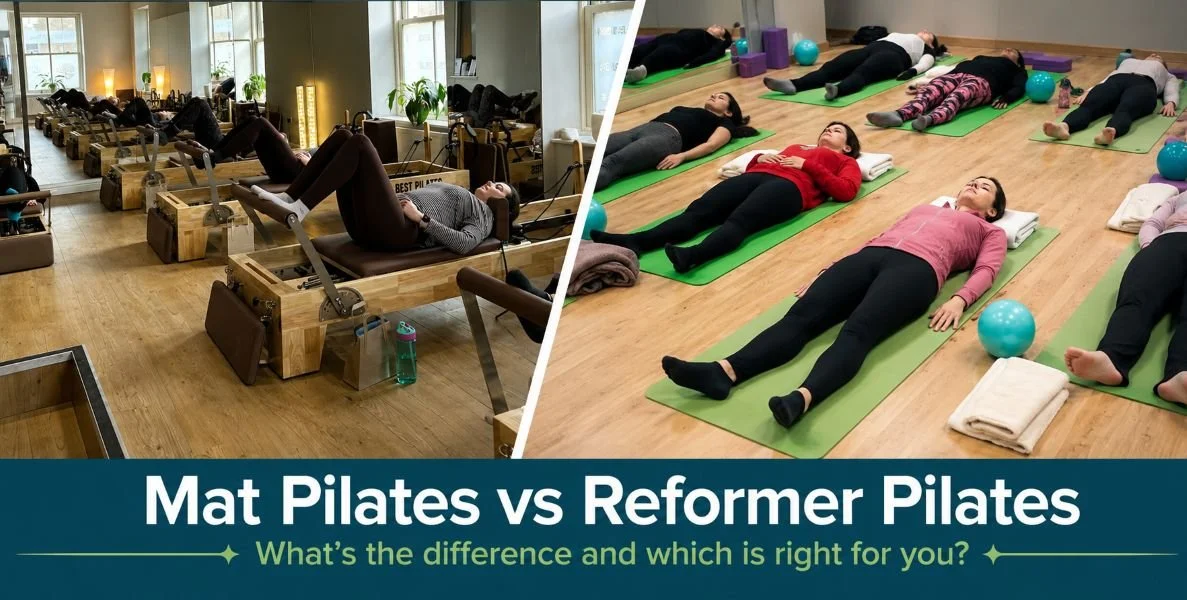
Reformer Pilates has exploded in popularity recently, with studios popping up everywhere. If you’re wondering what Reformer Pilates is, and how it’s different to mat pilates, this article should help.
While both mat and reformer pilates are based on the same principles developed by Joseph Pilates, they offer quite different experiences. Understanding the differences can help you decide which style is right for you.
What is Mat Pilates?
Mat Pilates is performed on a yoga-style mat using your own body weight as resistance. Classes typically involve a series of controlled exercises designed to strengthen the core, improve mobility, particularly in the spine, and enhance body awareness. Exercises can be done lying down, kneeling, sitting, side lying or standing.
Small pieces of equipment such as resistance bands or Pilates balls may occasionally be used to add variety and challenge, or the class may be done without any equipment at all.
Mat Pilates is performed on a yoga-style mat using your own body weight as resistance. Classes typically involve a series of controlled exercises designed to strengthen the core, improve mobility, particularly in the spine, and enhance body awareness. Exercises can be done lying down, kneeling, sitting, side lying or standing.
Small pieces of equipment such as resistance bands or Pilates balls may occasionally be used to add variety and challenge, or the class may be done without any equipment at all.
Benefits of Mat Pilates
Improves core strength and stability
Enhances posture and alignment
Develops body awareness and movement control
Improves flexibility and mobility
Requires minimal equipment
Can be practised almost anywhere
Offers greater exercise variety
Because you are working against gravity using your own body weight, Mat Pilates can be challenging, particularly for the abdominal and postural muscles.
What is Reformer Pilates?
Reformer Pilates is performed on a specialised piece of equipment called a reformer. The reformer consists of a sliding carriage attached to springs that provide adjustable resistance.
See overview of the reformer here
Exercises can be performed lying down, sitting, kneeling, standing, or even balancing on the moving carriage. The springs can either increase the challenge or provide support, making exercises more accessible. The equipment offers a lot of feedback throughout, and you’ll soon discover muscular imbalance or areas that haven’t worked for a while.
Benefits of Reformer Pilates
Builds full-body strength
Provides adjustable resistance for progression
Supports rehabilitation and injury recovery
Improves balance and coordination
Can assist people who struggle with traditional floor-based exercises
The reformer allows for both assistance and resistance, making it highly adaptable for beginners, athletes, and those recovering from injury.
The Main Differences
Resistance
Mat Pilates: Uses your body weight and gravity as resistance.
Reformer Pilates: Uses adjustable spring resistance, which can either support movement or make an exercise more challenging.
Accessibility
Mat Pilates: Requires getting down onto the floor, supporting your own body weight and transitioning between positions.
Reformer Pilates: Provides support through the equipment, making some exercises easier for those with mobility limitations.
Strength Building
Mat Pilates: Excellent for developing core strength and muscular endurance.
Reformer Pilates: Allows for greater progressive resistance and can build overall body strength more effectively.
Cost
Mat Pilates: Generally more affordable and widely available.
Reformer Pilates: Usually more expensive due to specialised equipment and smaller class sizes.
Exercise Variety
Mat Pilates: Relies on bodyweight exercises and small equipment.
Reformer Pilates: Offers hundreds of exercise variations using springs, straps, pulleys, and the moving carriage.
Which is Better for Beginners?
Many people assume Reformer Pilates is more advanced because of the equipment, but often the opposite is true.
For some beginners, especially those with lower fitness levels, joint pain, injuries, or limited mobility, the reformer can actually make movements more accessible by providing support through the springs.
Mat Pilates can sometimes feel harder because you don't have that assistance and must support your own body weight throughout many exercises.
The reformer offers continual feedback, so it’s easy to feel if one area is over-working, one area is more restricted or some muscles are not used to supporting you. On the mat, you’re relying on your own internal feedback, which can be less reliable.
A well-taught beginner Mat Pilates class, however, remains one of the best ways to learn the fundamental Pilates principles of breathing, alignment, core engagement, and movement control.
Who is Mat Pilates Suitable For?
Mat Pilates may be ideal if you:
Want to improve core strength and posture
Enjoy exercising in a group setting
Are looking for a cost-effective option
Want something you can practise at home, or via a Zoom option.
Enjoy bodyweight training
Are recovering from pregnancy and have been medically cleared to exercise
Mat Pilates is particularly effective for developing functional movement patterns that can transfer into everyday life.
Who is Reformer Pilates Suitable For?
Reformer Pilates may be ideal if you:
Want to build strength throughout the whole body
Are managing injury
Have joint pain or mobility restrictions
Enjoy equipment-based exercise
Want highly personalised progression
Are looking for a greater strength challenge
The adaptability of the reformer makes it popular with everyone from complete beginners to elite athletes.
What about both?
Mat Pilates and Reformer Pilates definitely aren't competitors. Many clients are Move Well like to do a combination of both styles, as the two complement each other perfectly
Mat Pilates develops body awareness, core control, and movement fundamentals. Reformer Pilates adds resistance, support, and variety that can accelerate strength gains and rehabilitation. It’s also excellent for highlighting movement compensation patterns.
If your goal is long-term strength, mobility, and resilience, the best option may be to incorporate both at different stages of your fitness journey.
The most important factor isn't whether you choose mat or reformer Pilates—it's finding a skilled instructor who can help you move well, feel safe as you move, and work towards your individual goals.
→ View our classes and timetable